
Open Banking enables customers to pay directly from their bank account - without cards, intermediaries, or stored payment details. Using secure bank APIs under PSD2 regulation, payments are initiated in real time and authorized within the customer’s own banking environment. The result is a faster, more secure way to move money - fully aligned with how digital payments are evolving across Europe and the UK.
How it works
-
Payment selectionThe customer selects Open Banking at checkout
-
Transaction DataCustomer enters required transaction data
-
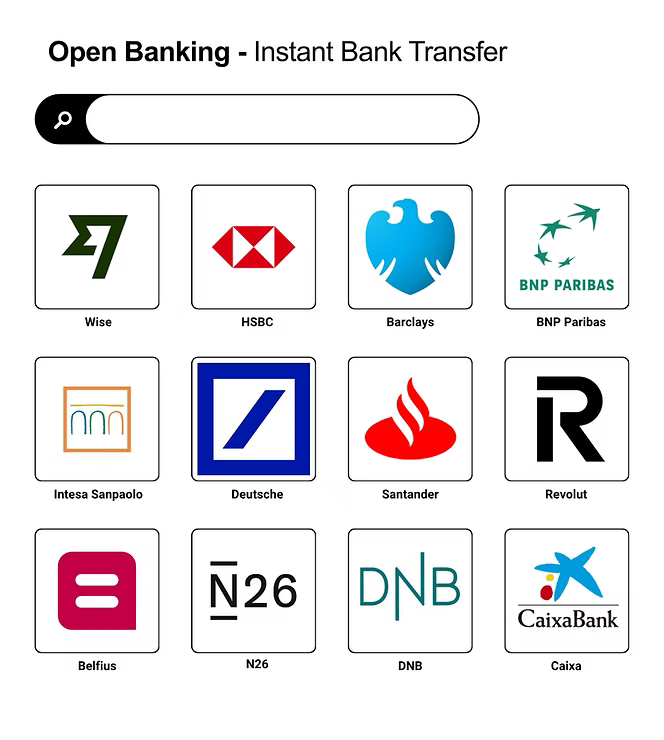
Choose BankCustomer is redirected to Moneevo where they select their bank
-
AuthenticationThey are redirected to their bank and authenticate using familiar methods (biometrics, app approval, or one-time code)
-
AuthorizationThe payment is confirmed directly within the bank
-
ConfirmationYou receive real-time status of the transaction
why businesses are adopting open banking
Businesses are not replacing cards - but they are no longer relying on them exclusively. Open Banking introduces a second payment rail that addresses some of the structural limitations of card-based transactions, particularly in online and cross-border environments.
In practice, this means:
Direct bank payments:
Funds move directly from customer to merchant- no card networks involved
Strong security by design:
Every payment is authenticated by the bank using Strong Customer Authentication (SCA)
Real-time visibility:
Know immediately whether a payment is successful
No chargebacks:
Eliminate disputes associated with card payments
Lower dependency on card networks:
Diversify your payment stack and reduce reliance on a single rail